Mollusca · mollusks
Atlantic jackknife clam
Ensis leei
Pharidae · razor clamsIUCN: Not evaluated
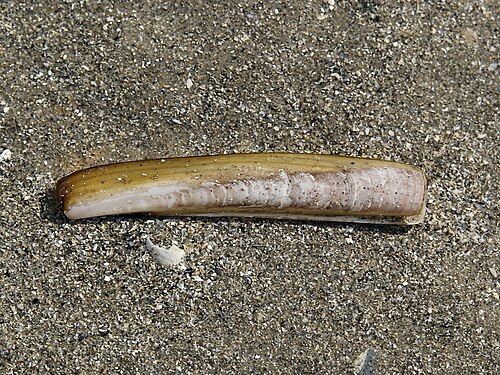

A long, narrow razor clam that can burrow fast enough to escape a digger.
Fun factIts digging is so efficient that MIT engineers built a burrowing robot based on it.
- Waters
- Northeast US, Northwest Atlantic
- Depth zone
- Intertidal shore, Coastal shallows & estuaries
- Diet
- Plankton (filter feeder)
- Size
- Shell up to 20 cm
Classification
Mollusca › Bivalvia › Pharidae
- Kingdom Animalia animals
- Many-celled organisms that eat other living things for energy (heterotrophs)
- Cells have no cell walls
- Most can move at some stage of life
- Clade Bilateria bilateral animals
- Body has a left and right side that mirror each other (bilateral symmetry)
- Head end with concentrated nerves; three tissue layers
- Includes about 99% of all living animal species
- Clade Protostomia protostomes
- In the embryo, the first opening usually becomes the mouth
- Main nerve cord runs along the belly (ventral)
- Includes mollusks, worms, and arthropods
- Clade Spiralia mollusks, worms & kin
- Embryos usually divide in a spiral pattern (spiral cleavage)
- Many have a swimming larva with a band of cilia (trochophore)
- Includes mollusks and segmented worms
- Phylum Mollusca mollusks
- Soft body with a muscular foot and a fold of tissue (mantle) that makes the shell
- Most have a rasping, tongue-like ribbon of teeth (radula)
- Includes snails, clams, octopuses, and chitons
- Class Bivalvia clams, oysters & kin
- Body enclosed in two hinged shells (valves)
- No head and no radula
- Most filter food from water with large gills
- Subclass Heterodonta clams & cockles
- Hinge has distinct cardinal and lateral teeth
- Many burrow in sediment using a long siphon
- Includes clams and cockles
- Family Pharidae razor clams
- Razor clams: long, narrow shells
- Dig very fast with a powerful foot
- Genus Ensis
- Species in the same genus are very close relatives and often look alike.
- Species Ensis leei Atlantic jackknife clam
Closest relatives in the guide
- Atlantic sea scallop Placopecten magellanicus same class
- Atlantic surfclam Spisula solidissima same class
- Bay scallop Argopecten irradians same class
- Blue mussel Mytilus edulis same class
- Eastern oyster Crassostrea virginica same class
- Giant clam Tridacna gigas same class
- Hard clam Mercenaria mercenaria same class
- Ocean quahog Arctica islandica same class