Chordata · chordates
Atlantic torpedo
Tetronarce nobiliana
Torpedinidae · torpedo raysIUCN: Least Concern
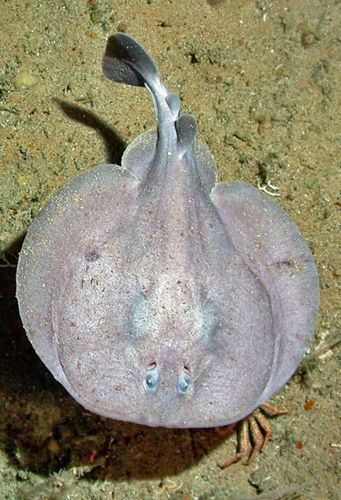

A large electric ray that can generate up to 220 volts.
Fun factAncient Greek doctors used electric rays to numb pain.
- Waters
- Northeast US, Northwest Atlantic, Northeast Atlantic
- Depth zone
- Continental shelf
- Diet
- Fish
- Size
- Up to 1.8 m
Classification
Chordata › Chondrichthyes › Torpediniformes › Torpedinidae
- Kingdom Animalia animals
- Many-celled organisms that eat other living things for energy (heterotrophs)
- Cells have no cell walls
- Most can move at some stage of life
- Clade Bilateria bilateral animals
- Body has a left and right side that mirror each other (bilateral symmetry)
- Head end with concentrated nerves; three tissue layers
- Includes about 99% of all living animal species
- Clade Deuterostomia deuterostomes
- In the embryo, the first opening becomes the anus and the mouth forms second
- Includes echinoderms and chordates
- Phylum Chordata chordates
- At some stage of life: a stiffening rod along the back (notochord)
- A hollow nerve cord along the back (dorsal)
- Slits in the throat (pharyngeal slits) and a tail past the anus
- Subphylum Vertebrata vertebrates
- A skull (cranium) protecting a brain
- Backbone or similar support around the nerve cord
- Includes fishes, amphibians, reptiles, birds, and mammals
- Infraphylum Gnathostomata jawed vertebrates
- Jawed vertebrates: jaws formed from gill arches
- Paired fins or limbs
- Includes all fishes except hagfish and lampreys, plus all tetrapods
- Class Chondrichthyes cartilaginous fishes
- Skeleton made of cartilage, not bone
- Skin covered in tooth-like scales (denticles)
- Teeth constantly replaced; males have claspers for mating
- Subclass Elasmobranchii sharks & rays
- Sharks and rays: five to seven separate gill slits on each side
- Many rows of replaceable teeth
- Superorder Batoidea rays & skates
- Rays and skates: flattened bodies with gill slits underneath
- Pectoral fins joined to the head
- Many have crushing, pavement-like teeth
- Order Torpediniformes electric rays
- Electric rays: rounded disc with electric organs in the wings
- Family Torpedinidae torpedo rays
- Torpedo rays can deliver shocks over 200 volts
- Genus Tetronarce
- Species in the same genus are very close relatives and often look alike.
- Species Tetronarce nobiliana Atlantic torpedo
Closest relatives in the guide
- Atlantic angel shark Squatina dumeril same class
- Atlantic sharpnose shark Rhizoprionodon terraenovae same class
- Barndoor skate Dipturus laevis same class
- Basking shark Cetorhinus maximus same class
- Blue shark Prionace glauca same class
- Bluntnose sixgill shark Hexanchus griseus same class
- Bull shark Carcharhinus leucas same class
- Clearnose skate Rostroraja eglanteria same class