Annelida · segmented worms
Bobbit worm
Eunice aphroditois
Eunicidae · eunicid wormsIUCN: Not evaluated
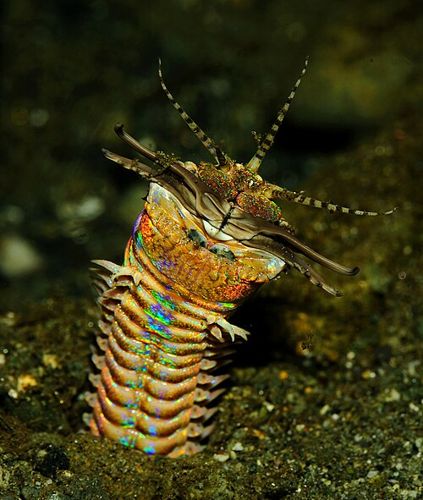

A long, buried ambush predator with scissor-like jaws.
Fun factIt can strike so fast that it cuts small fish in half.
- Waters
- Indo-Pacific
- Depth zone
- Coral reefs
- Diet
- Fish & invertebrates
- Size
- Up to 3 m
Classification
Annelida › Eunicidae
- Kingdom Animalia animals
- Many-celled organisms that eat other living things for energy (heterotrophs)
- Cells have no cell walls
- Most can move at some stage of life
- Clade Bilateria bilateral animals
- Body has a left and right side that mirror each other (bilateral symmetry)
- Head end with concentrated nerves; three tissue layers
- Includes about 99% of all living animal species
- Clade Protostomia protostomes
- In the embryo, the first opening usually becomes the mouth
- Main nerve cord runs along the belly (ventral)
- Includes mollusks, worms, and arthropods
- Clade Spiralia mollusks, worms & kin
- Embryos usually divide in a spiral pattern (spiral cleavage)
- Many have a swimming larva with a band of cilia (trochophore)
- Includes mollusks and segmented worms
- Phylum Annelida segmented worms
- Segmented worms: body divided into repeated ring-like segments
- Bristles (chaetae) help many grip and move
- Includes bristle worms, earthworms, and leeches
- Clade Errantia free-living bristle worms
- Free-moving bristle worms
- Paddle-like side flaps (parapodia) on each segment
- Often have jaws and are active predators
- Family Eunicidae eunicid worms
- Long worms with complex jaws (several pairs of jaw plates)
- Some, like the bobbit worm, ambush prey from burrows
- Genus Eunice
- Species in the same genus are very close relatives and often look alike.
- Species Eunice aphroditois Bobbit worm