Arthropoda · arthropods
Calanus copepod
Calanus finmarchicus
Calanidae · calanoid copepodsIUCN: Not evaluated
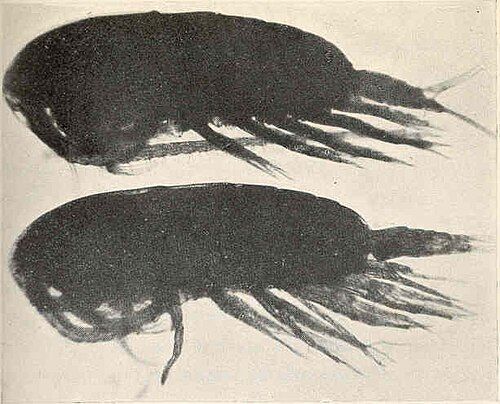

A small, fat-rich copepod and one of the most abundant animals in the North Atlantic.
Fun factIt is the main food of North Atlantic right whales. As it shifts north, the whales follow.
- Waters
- Northeast US, Northwest Atlantic, Northeast Atlantic, Arctic Ocean
- Depth zone
- Open-ocean surface waters, Twilight zone, 200–1,000 m
- Diet
- Phytoplankton
- Size
- About 3 mm
Classification
Arthropoda › Copepoda › Calanidae
- Kingdom Animalia animals
- Many-celled organisms that eat other living things for energy (heterotrophs)
- Cells have no cell walls
- Most can move at some stage of life
- Clade Bilateria bilateral animals
- Body has a left and right side that mirror each other (bilateral symmetry)
- Head end with concentrated nerves; three tissue layers
- Includes about 99% of all living animal species
- Clade Protostomia protostomes
- In the embryo, the first opening usually becomes the mouth
- Main nerve cord runs along the belly (ventral)
- Includes mollusks, worms, and arthropods
- Clade Ecdysozoa molting animals
- Grow by shedding their outer layer (molting, ecdysis)
- No cilia used for movement
- Includes arthropods and nematode worms
- Phylum Arthropoda arthropods
- Hard outer skeleton made of chitin (exoskeleton)
- Jointed legs and a segmented body
- The largest animal phylum by species count
- Subphylum Crustacea crustaceans
- Two pairs of antennae
- Branched (biramous) legs in many species
- Most breathe with gills
- Class Copepoda copepods
- Tiny crustaceans, mostly 1–2 mm
- Long first antennae and a single eye
- Probably the most abundant animals in the ocean
- Family Calanidae calanoid copepods
- Calanoid copepods that store fat; key food for right whales and herring
- Genus Calanus
- Species in the same genus are very close relatives and often look alike.
- Species Calanus finmarchicus Calanus copepod