Annelida · segmented worms
Clam worm
Alitta virens
Nereididae · ragwormsIUCN: Not evaluated
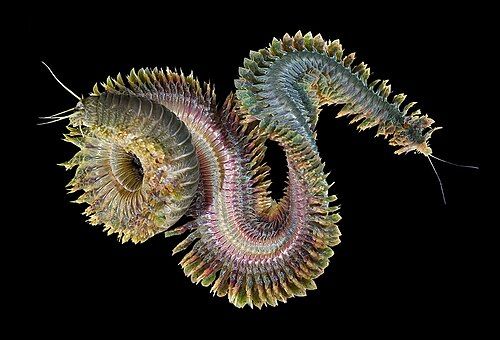

A large iridescent bristle worm of mudflats. It is sold as sandworm bait.
Fun factMaine's bait-worm harvest is worth millions of dollars a year.
- Waters
- Northeast US, Northwest Atlantic, Northeast Atlantic
- Depth zone
- Intertidal shore, Coastal shallows & estuaries
- Diet
- Small invertebrates & algae
- Size
- Usually about 30 cm
Classification
Annelida › Nereididae
- Kingdom Animalia animals
- Many-celled organisms that eat other living things for energy (heterotrophs)
- Cells have no cell walls
- Most can move at some stage of life
- Clade Bilateria bilateral animals
- Body has a left and right side that mirror each other (bilateral symmetry)
- Head end with concentrated nerves; three tissue layers
- Includes about 99% of all living animal species
- Clade Protostomia protostomes
- In the embryo, the first opening usually becomes the mouth
- Main nerve cord runs along the belly (ventral)
- Includes mollusks, worms, and arthropods
- Clade Spiralia mollusks, worms & kin
- Embryos usually divide in a spiral pattern (spiral cleavage)
- Many have a swimming larva with a band of cilia (trochophore)
- Includes mollusks and segmented worms
- Phylum Annelida segmented worms
- Segmented worms: body divided into repeated ring-like segments
- Bristles (chaetae) help many grip and move
- Includes bristle worms, earthworms, and leeches
- Clade Errantia free-living bristle worms
- Free-moving bristle worms
- Paddle-like side flaps (parapodia) on each segment
- Often have jaws and are active predators
- Family Nereididae ragworms
- Ragworms and clam worms with many paddle-like legs
- Strong jaws; sold as fishing bait
- Genus Alitta
- Species in the same genus are very close relatives and often look alike.
- Species Alitta virens Clam worm