Mollusca · mollusks
Common periwinkle
Littorina littorea
Littorinidae · periwinklesIUCN: Not evaluated
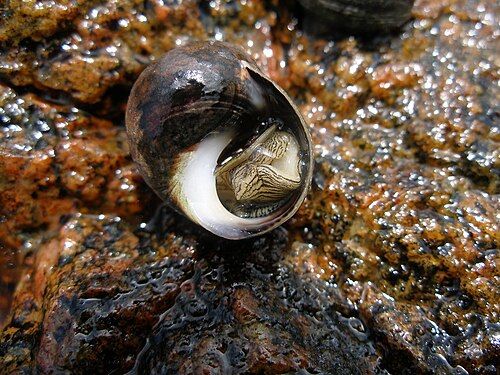

A small snail that grazes rocky shores. It probably arrived from Europe in ships' rock ballast in the 1800s.
Fun factIts grazing changed which seaweeds and marsh plants grow along New England shores.
- Waters
- Northeast US, Northwest Atlantic, Northeast Atlantic
- Depth zone
- Intertidal shore
- Diet
- Algae (grazer)
- Size
- Shell up to 5 cm
Classification
Mollusca › Gastropoda › Littorinimorpha › Littorinidae
- Kingdom Animalia animals
- Many-celled organisms that eat other living things for energy (heterotrophs)
- Cells have no cell walls
- Most can move at some stage of life
- Clade Bilateria bilateral animals
- Body has a left and right side that mirror each other (bilateral symmetry)
- Head end with concentrated nerves; three tissue layers
- Includes about 99% of all living animal species
- Clade Protostomia protostomes
- In the embryo, the first opening usually becomes the mouth
- Main nerve cord runs along the belly (ventral)
- Includes mollusks, worms, and arthropods
- Clade Spiralia mollusks, worms & kin
- Embryos usually divide in a spiral pattern (spiral cleavage)
- Many have a swimming larva with a band of cilia (trochophore)
- Includes mollusks and segmented worms
- Phylum Mollusca mollusks
- Soft body with a muscular foot and a fold of tissue (mantle) that makes the shell
- Most have a rasping, tongue-like ribbon of teeth (radula)
- Includes snails, clams, octopuses, and chitons
- Class Gastropoda snails & slugs
- Snails and slugs, most with a single, often coiled shell
- Body twists 180 degrees during development (torsion)
- Crawl on a broad muscular foot
- Subclass Caenogastropoda whelks, periwinkles & kin
- Most have a single gill and a shell door (operculum)
- Many have a siphon to sample water
- Includes periwinkles, whelks, and conchs
- Order Littorinimorpha periwinkles, conchs & kin
- Large, varied group including periwinkles, conchs, and moon snails
- Many graze algae; some drill or filter-feed
- Family Littorinidae periwinkles
- Periwinkles: small, rounded snails of rocky shores
- Many can survive long periods out of water
- Genus Littorina
- Species in the same genus are very close relatives and often look alike.
- Species Littorina littorea Common periwinkle
Closest relatives in the guide
- Atlantic slipper snail Crepidula fornicata same order
- Northern moon snail Euspira heros same order
- Queen conch Aliger gigas same order
- Atlantic oyster drill Urosalpinx cinerea same class
- Blue dragon Glaucus atlanticus same class
- California sea hare Aplysia californica same class
- Channeled whelk Busycotypus canaliculatus same class
- Geography cone Conus geographus same class