Echinodermata · echinoderms
Common sand dollar
Echinarachnius parma
Echinarachniidae · sand dollarsIUCN: Not evaluated
.jpg)
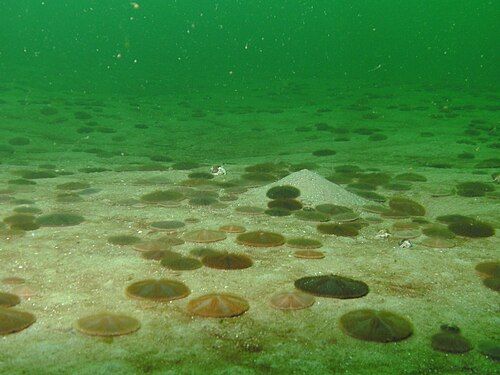
A flat, burrowing urchin with fine, velvety spines.
Fun factLiving sand dollars are purple-brown. The white ones on beaches are bleached skeletons.
- Waters
- Northeast US, Northwest Atlantic, North Pacific
- Depth zone
- Coastal shallows & estuaries, Continental shelf
- Diet
- Diatoms & detritus
- Size
- Up to 8 cm
Classification
Echinodermata › Echinoidea › Echinarachniidae
- Kingdom Animalia animals
- Many-celled organisms that eat other living things for energy (heterotrophs)
- Cells have no cell walls
- Most can move at some stage of life
- Clade Bilateria bilateral animals
- Body has a left and right side that mirror each other (bilateral symmetry)
- Head end with concentrated nerves; three tissue layers
- Includes about 99% of all living animal species
- Clade Deuterostomia deuterostomes
- In the embryo, the first opening becomes the anus and the mouth forms second
- Includes echinoderms and chordates
- Phylum Echinodermata echinoderms
- Adults usually have five-part radial symmetry
- Water-vascular system powers tiny tube feet
- Skeleton of limestone plates (ossicles) in the skin
- Class Echinoidea sea urchins & sand dollars
- Sea urchins and sand dollars: rigid, rounded shell (test) of fused plates
- Covered in movable spines
- Jaw apparatus called Aristotle's lantern
- Family Echinarachniidae sand dollars
- Sand dollars: flat, disc-shaped urchins with tiny velvety spines
- Petal pattern on top marks the breathing tube feet
- Genus Echinarachnius
- Species in the same genus are very close relatives and often look alike.
- Species Echinarachnius parma Common sand dollar
Closest relatives in the guide
- Green sea urchin Strongylocentrotus droebachiensis same class
- Long-spined sea urchin Diadema antillarum same class
- Red sea urchin Mesocentrotus franciscanus same class