Mollusca · mollusks
Dumbo octopus
Grimpoteuthis bathynectes
Opisthoteuthidae · dumbo octopusesIUCN: Data Deficient
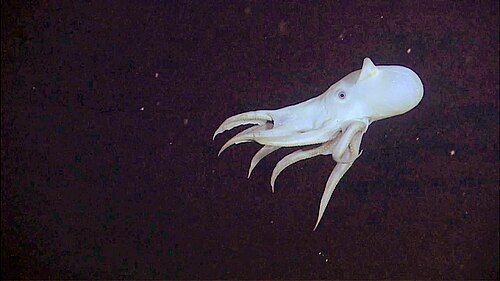

A deep-sea octopus with ear-like fins that it flaps to swim.
Fun factDumbo octopuses have been filmed nearly 7,000 m down, deeper than any other known octopus.
- Waters
- Worldwide, Eastern Pacific
- Depth zone
- Deep sea & continental slope
- Diet
- Copepods & worms
- Size
- Up to 30 cm
Classification
Mollusca › Cephalopoda › Octopoda › Opisthoteuthidae
- Kingdom Animalia animals
- Many-celled organisms that eat other living things for energy (heterotrophs)
- Cells have no cell walls
- Most can move at some stage of life
- Clade Bilateria bilateral animals
- Body has a left and right side that mirror each other (bilateral symmetry)
- Head end with concentrated nerves; three tissue layers
- Includes about 99% of all living animal species
- Clade Protostomia protostomes
- In the embryo, the first opening usually becomes the mouth
- Main nerve cord runs along the belly (ventral)
- Includes mollusks, worms, and arthropods
- Clade Spiralia mollusks, worms & kin
- Embryos usually divide in a spiral pattern (spiral cleavage)
- Many have a swimming larva with a band of cilia (trochophore)
- Includes mollusks and segmented worms
- Phylum Mollusca mollusks
- Soft body with a muscular foot and a fold of tissue (mantle) that makes the shell
- Most have a rasping, tongue-like ribbon of teeth (radula)
- Includes snails, clams, octopuses, and chitons
- Class Cephalopoda cephalopods
- Foot is modified into arms and tentacles around the head
- Large brains and camera-like eyes
- Jet propulsion by squirting water through a funnel (siphon)
- Subclass Coleoidea octopuses, squids & cuttlefish
- Shell is internal, reduced, or absent
- Most have an ink sac and color-changing skin cells (chromatophores)
- Includes octopuses, squids, and cuttlefish
- Superorder Octopodiformes octopuses & vampire squid
- Eight arms, with no long feeding tentacles
- Includes octopuses and the vampire squid
- Order Octopoda octopuses
- Octopuses: eight arms with suckers and a rounded body with no internal shell
- Can squeeze through any gap larger than their beak
- Suborder Cirrata finned octopuses
- Deep-sea octopuses with ear-like fins on the body
- Arms bear fleshy filaments (cirri) and are joined by webbing
- Family Opisthoteuthidae dumbo octopuses
- Dumbo octopuses: soft, gelatinous deep-sea octopuses with ear-like fins
- Arms are webbed almost to the tips
- Genus Grimpoteuthis
- Species in the same genus are very close relatives and often look alike.
- Species Grimpoteuthis bathynectes Dumbo octopus
Closest relatives in the guide
- Common octopus Octopus vulgaris same order
- Giant Pacific octopus Enteroctopus dofleini same order
- Greater argonaut Argonauta argo same order
- Greater blue-ringed octopus Hapalochlaena lunulata same order
- Chambered nautilus Nautilus pompilius same class
- Colossal squid Mesonychoteuthis hamiltoni same class
- Common cuttlefish Sepia officinalis same class
- Flamboyant cuttlefish Metasepia pfefferi same class