Arthropoda · arthropods
Dungeness crab
Metacarcinus magister
Cancridae · rock crabsIUCN: Not evaluated
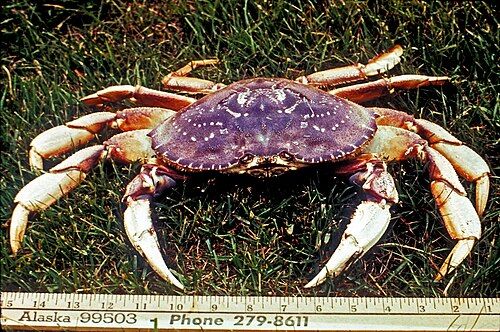

The most valuable crab fishery on the US West Coast.
Fun factFishing seasons are often delayed by domoic acid from harmful algal blooms.
- Waters
- North Pacific, Eastern Pacific
- Depth zone
- Coastal shallows & estuaries, Continental shelf
- Diet
- Clams, fish & small crustaceans
- Size
- Carapace up to 25 cm
Classification
Arthropoda › Malacostraca › Decapoda › Cancridae
- Kingdom Animalia animals
- Many-celled organisms that eat other living things for energy (heterotrophs)
- Cells have no cell walls
- Most can move at some stage of life
- Clade Bilateria bilateral animals
- Body has a left and right side that mirror each other (bilateral symmetry)
- Head end with concentrated nerves; three tissue layers
- Includes about 99% of all living animal species
- Clade Protostomia protostomes
- In the embryo, the first opening usually becomes the mouth
- Main nerve cord runs along the belly (ventral)
- Includes mollusks, worms, and arthropods
- Clade Ecdysozoa molting animals
- Grow by shedding their outer layer (molting, ecdysis)
- No cilia used for movement
- Includes arthropods and nematode worms
- Phylum Arthropoda arthropods
- Hard outer skeleton made of chitin (exoskeleton)
- Jointed legs and a segmented body
- The largest animal phylum by species count
- Subphylum Crustacea crustaceans
- Two pairs of antennae
- Branched (biramous) legs in many species
- Most breathe with gills
- Class Malacostraca crabs, shrimp & kin
- Body of a head, 8-segment thorax, and 6-segment abdomen
- Includes crabs, shrimp, lobsters, krill, and isopods
- Order Decapoda ten-legged crustaceans
- Ten walking legs, the first pair often with claws
- Shell covers head and thorax together (carapace)
- Suborder Pleocyemata egg-brooding decapods
- Females carry their eggs under the abdomen until they hatch
- Includes true crabs, lobsters, and most shrimp
- Infraorder Brachyura true crabs
- True crabs: abdomen tucked tightly under a broad carapace
- Walk sideways on four pairs of legs
- Family Cancridae rock crabs
- Rock crabs: broad, oval carapace
- Many are commercial species
- Genus Metacarcinus
- Species in the same genus are very close relatives and often look alike.
- Species Metacarcinus magister Dungeness crab
Closest relatives in the guide
- Atlantic rock crab Cancer irroratus same family
- Jonah crab Cancer borealis same family
- American lobster Homarus americanus same order
- Asian shore crab Hemigrapsus sanguineus same order
- Atlantic ghost crab Ocypode quadrata same order
- Atlantic marsh fiddler crab Minuca pugnax same order
- Atlantic mole crab Emerita talpoida same order
- Atlantic white shrimp Penaeus setiferus same order