Arthropoda · arthropods
Japanese spider crab
Macrocheira kaempferi
Inachidae · spider crabsIUCN: Not evaluated
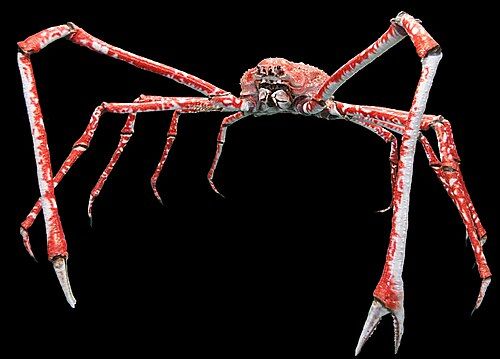

The arthropod with the longest legs in the world.
Fun factWhen it molts, it pulls its whole body, legs and all, out of the old shell, which takes about 100 minutes.
- Waters
- Western Pacific
- Depth zone
- Continental shelf, Deep sea & continental slope
- Diet
- Carrion & shellfish
- Size
- Leg span up to 3.7 m
Classification
Arthropoda › Malacostraca › Decapoda › Inachidae
- Kingdom Animalia animals
- Many-celled organisms that eat other living things for energy (heterotrophs)
- Cells have no cell walls
- Most can move at some stage of life
- Clade Bilateria bilateral animals
- Body has a left and right side that mirror each other (bilateral symmetry)
- Head end with concentrated nerves; three tissue layers
- Includes about 99% of all living animal species
- Clade Protostomia protostomes
- In the embryo, the first opening usually becomes the mouth
- Main nerve cord runs along the belly (ventral)
- Includes mollusks, worms, and arthropods
- Clade Ecdysozoa molting animals
- Grow by shedding their outer layer (molting, ecdysis)
- No cilia used for movement
- Includes arthropods and nematode worms
- Phylum Arthropoda arthropods
- Hard outer skeleton made of chitin (exoskeleton)
- Jointed legs and a segmented body
- The largest animal phylum by species count
- Subphylum Crustacea crustaceans
- Two pairs of antennae
- Branched (biramous) legs in many species
- Most breathe with gills
- Class Malacostraca crabs, shrimp & kin
- Body of a head, 8-segment thorax, and 6-segment abdomen
- Includes crabs, shrimp, lobsters, krill, and isopods
- Order Decapoda ten-legged crustaceans
- Ten walking legs, the first pair often with claws
- Shell covers head and thorax together (carapace)
- Suborder Pleocyemata egg-brooding decapods
- Females carry their eggs under the abdomen until they hatch
- Includes true crabs, lobsters, and most shrimp
- Infraorder Brachyura true crabs
- True crabs: abdomen tucked tightly under a broad carapace
- Walk sideways on four pairs of legs
- Family Inachidae spider crabs
- Spider crabs with long, thin legs
- Includes the Japanese spider crab
- Genus Macrocheira
- Species in the same genus are very close relatives and often look alike.
- Species Macrocheira kaempferi Japanese spider crab
Closest relatives in the guide
- American lobster Homarus americanus same order
- Asian shore crab Hemigrapsus sanguineus same order
- Atlantic ghost crab Ocypode quadrata same order
- Atlantic marsh fiddler crab Minuca pugnax same order
- Atlantic mole crab Emerita talpoida same order
- Atlantic rock crab Cancer irroratus same order
- Atlantic white shrimp Penaeus setiferus same order
- Bigclaw snapping shrimp Alpheus heterochaelis same order