Chordata · chordates
Northern elephant seal
Mirounga angustirostris
Phocidae · true sealsIUCN: Least Concern
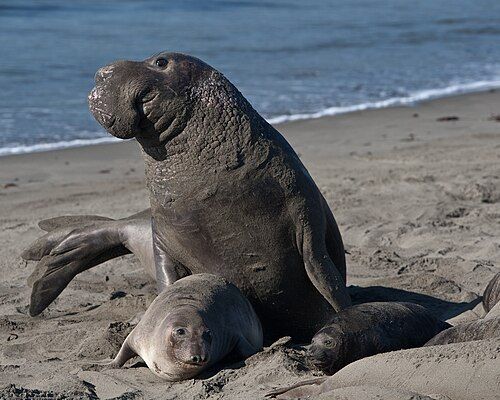

A huge seal whose males have trunk-like noses. It recovered from fewer than 100 animals.
Fun factIt spends about 90% of its time at sea underwater, diving deeper than 1,500 m.
- Waters
- North Pacific, Eastern Pacific
- Depth zone
- Open-ocean surface waters, Deep sea & continental slope
- Diet
- Squid & fish
- Size
- Up to 5 m, 2 tonnes
Classification
Chordata › Mammalia › Carnivora › Phocidae
- Kingdom Animalia animals
- Many-celled organisms that eat other living things for energy (heterotrophs)
- Cells have no cell walls
- Most can move at some stage of life
- Clade Bilateria bilateral animals
- Body has a left and right side that mirror each other (bilateral symmetry)
- Head end with concentrated nerves; three tissue layers
- Includes about 99% of all living animal species
- Clade Deuterostomia deuterostomes
- In the embryo, the first opening becomes the anus and the mouth forms second
- Includes echinoderms and chordates
- Phylum Chordata chordates
- At some stage of life: a stiffening rod along the back (notochord)
- A hollow nerve cord along the back (dorsal)
- Slits in the throat (pharyngeal slits) and a tail past the anus
- Subphylum Vertebrata vertebrates
- A skull (cranium) protecting a brain
- Backbone or similar support around the nerve cord
- Includes fishes, amphibians, reptiles, birds, and mammals
- Infraphylum Gnathostomata jawed vertebrates
- Jawed vertebrates: jaws formed from gill arches
- Paired fins or limbs
- Includes all fishes except hagfish and lampreys, plus all tetrapods
- Superclass Osteichthyes bony vertebrates
- Bony vertebrates: skeleton made largely of bone
- Most have a lung or swim bladder
- Includes ray-finned and lobe-finned fishes and all tetrapods
- Clade Sarcopterygii lobe-finned vertebrates
- Lobe-finned: fleshy fins with bones like those of limbs
- Includes coelacanths, lungfishes, and all tetrapods
- Clade Tetrapoda four-limbed vertebrates
- Four limbs with fingers and toes (or descended from animals that had them)
- Breathe air with lungs
- Class Mammalia mammals
- Mammals: hair at some stage of life
- Females nurse their young with milk (mammary glands)
- Three small bones in the middle ear
- Superorder Laurasiatheria whales, carnivorans & kin
- Large group of placental mammals including whales, carnivores, bats, and hoofed animals
- Order Carnivora carnivorans
- Carnivorans: sharp cheek teeth for shearing meat (carnassials) in most
- Includes cats, dogs, bears, seals, and weasels
- Suborder Caniformia dog-like carnivorans
- Dog-like carnivorans: dogs, bears, weasels, and seals
- Clade Pinnipedia seals, sea lions & walrus
- Seals, sea lions, and walruses: limbs shaped into flippers
- Insulating blubber; come ashore or onto ice to breed
- Family Phocidae true seals
- True seals: no external ear flaps
- Swim with their back flippers and wriggle on land
- Genus Mirounga
- Species in the same genus are very close relatives and often look alike.
- Species Mirounga angustirostris Northern elephant seal
Closest relatives in the guide
- Gray seal Halichoerus grypus same family
- Harbor seal Phoca vitulina same family
- Harp seal Pagophilus groenlandicus same family
- Hawaiian monk seal Neomonachus schauinslandi same family
- Hooded seal Cystophora cristata same family
- Leopard seal Hydrurga leptonyx same family
- Weddell seal Leptonychotes weddellii same family
- Antarctic fur seal Arctocephalus gazella same order