Chordata · chordates
Patagonian toothfish
Dissostichus eleginoides
Nototheniidae · cod icefishesIUCN: Not evaluated
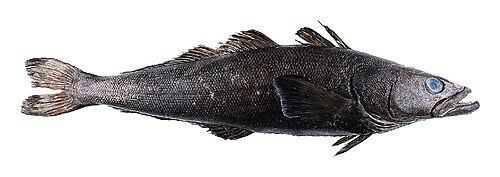

A large deep-water predator sold as Chilean sea bass.
Fun factThe name 'Chilean sea bass' was invented in 1977 to make it easier to sell.
- Waters
- South Atlantic, Southern Ocean
- Depth zone
- Deep sea & continental slope
- Diet
- Fish & squid
- Size
- Up to 2.3 m
Classification
Chordata › Actinopterygii › Perciformes › Nototheniidae
- Kingdom Animalia animals
- Many-celled organisms that eat other living things for energy (heterotrophs)
- Cells have no cell walls
- Most can move at some stage of life
- Clade Bilateria bilateral animals
- Body has a left and right side that mirror each other (bilateral symmetry)
- Head end with concentrated nerves; three tissue layers
- Includes about 99% of all living animal species
- Clade Deuterostomia deuterostomes
- In the embryo, the first opening becomes the anus and the mouth forms second
- Includes echinoderms and chordates
- Phylum Chordata chordates
- At some stage of life: a stiffening rod along the back (notochord)
- A hollow nerve cord along the back (dorsal)
- Slits in the throat (pharyngeal slits) and a tail past the anus
- Subphylum Vertebrata vertebrates
- A skull (cranium) protecting a brain
- Backbone or similar support around the nerve cord
- Includes fishes, amphibians, reptiles, birds, and mammals
- Infraphylum Gnathostomata jawed vertebrates
- Jawed vertebrates: jaws formed from gill arches
- Paired fins or limbs
- Includes all fishes except hagfish and lampreys, plus all tetrapods
- Superclass Osteichthyes bony vertebrates
- Bony vertebrates: skeleton made largely of bone
- Most have a lung or swim bladder
- Includes ray-finned and lobe-finned fishes and all tetrapods
- Class Actinopterygii ray-finned fishes
- Ray-finned fishes: fins are webs of skin held up by thin bony rays
- Usually a gas-filled swim bladder for buoyancy
- About half of all vertebrate species
- Infraclass Teleostei teleost fishes
- Teleosts: symmetrical tail fin
- Jaws that can push forward to grab prey (protrusible)
- About 96% of all living fishes
- Cohort Euteleostei salmon, cod, perch & kin
- A huge group that includes salmon, cod, and all spiny-finned fishes
- Clade Acanthomorpha spiny-rayed fishes
- Spiny-rayed fishes: true spines in the front of the fins
- Includes most familiar marine fishes
- Superorder Acanthopterygii spiny-finned fishes
- Spiny-finned fishes: sharp spines in the front of the dorsal and anal fins
- Pelvic fins usually under the pectoral fins
- Clade Percomorpha perch-like fishes
- The perch-like fishes: the largest group of vertebrates
- Pelvic fins with one spine and five rays (in most)
- Clade Eupercaria wrasses, groupers, pufferfishes & kin
- A very large group including wrasses, groupers, snappers, drums, anglerfishes, and pufferfishes
- Order Perciformes perches, groupers & sculpins
- Perches, groupers, scorpionfishes, and sculpins in this modern classification
- Suborder Notothenioidei Antarctic icefishes & kin
- Antarctic fishes with antifreeze proteins in their blood
- Most lack a swim bladder
- Family Nototheniidae cod icefishes
- Cod icefishes, including toothfishes
- Genus Dissostichus
- Species in the same genus are very close relatives and often look alike.
- Species Dissostichus eleginoides Patagonian toothfish
Closest relatives in the guide
- Antarctic toothfish Dissostichus mawsoni same genus
- Acadian redfish Sebastes fasciatus same order
- Atlantic goliath grouper Epinephelus itajara same order
- Atlantic wolffish Anarhichas lupus same order
- Black sea bass Centropristis striata same order
- Giant grouper Epinephelus lanceolatus same order
- Longhorn sculpin Myoxocephalus octodecemspinosus same order
- Lumpfish Cyclopterus lumpus same order