Cnidaria · cnidarians
Portuguese man o' war
Physalia physalis
Physaliidae · man o' warsIUCN: Not evaluated
.jpg)
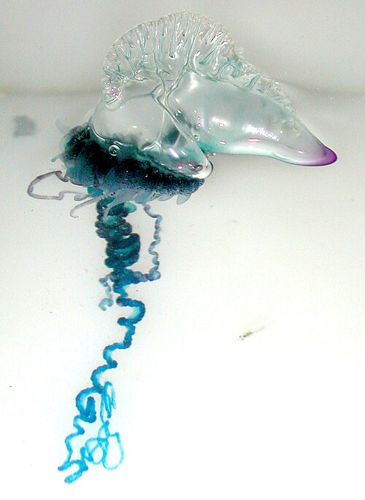
A colonial siphonophore made of specialized zooids, held up by a gas-filled float.
Fun factIt isn't a single animal. It's a colony of specialized individuals that can't survive alone.
- Waters
- Worldwide, Northeast US
- Depth zone
- Open-ocean surface waters
- Diet
- Small fish & larvae
- Size
- Float up to 30 cm; tentacles to 30 m
Classification
Cnidaria › Hydrozoa › Siphonophorae › Physaliidae
- Kingdom Animalia animals
- Many-celled organisms that eat other living things for energy (heterotrophs)
- Cells have no cell walls
- Most can move at some stage of life
- Phylum Cnidaria cnidarians
- Radially symmetric bodies with one opening that is both mouth and anus
- Stinging cells (cnidocytes) fire tiny harpoons (nematocysts)
- Two body forms: an attached polyp and a swimming bell (medusa)
- Class Hydrozoa hydrozoans
- Mostly small, often colonial animals with both polyp and medusa stages
- Medusae have a shelf of tissue (velum) under the bell
- Includes hydroids, fire corals, and siphonophores
- Order Siphonophorae siphonophores
- Floating colonies of specialized individuals (zooids) that work as one animal
- Different zooids swim, feed, sting, or reproduce
- Family Physaliidae man o' wars
- Siphonophores with a gas-filled float (pneumatophore) at the surface
- Long trailing stinging tentacles
- Genus Physalia
- Species in the same genus are very close relatives and often look alike.
- Species Physalia physalis Portuguese man o' war
Closest relatives in the guide
- Giant siphonophore Praya dubia same order
- By-the-wind sailor Velella velella same class
- Immortal jellyfish Turritopsis dohrnii same class