Chordata · chordates
Pyrosome
Pyrosoma atlanticum
Pyrosomatidae · pyrosomesIUCN: Not evaluated
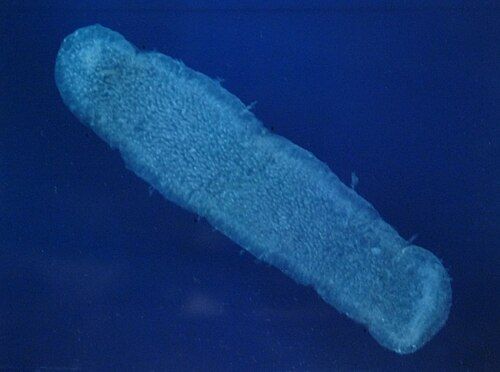

A glowing, tube-shaped colony of tunicates that drifts through the open ocean.
Fun factIts name means 'fire body' because of its bioluminescence.
- Waters
- Worldwide
- Depth zone
- Open-ocean surface waters, Twilight zone, 200–1,000 m
- Diet
- Phytoplankton (filter feeder)
- Size
- Colonies up to 60 cm
Classification
Chordata › Pyrosomatidae
- Kingdom Animalia animals
- Many-celled organisms that eat other living things for energy (heterotrophs)
- Cells have no cell walls
- Most can move at some stage of life
- Clade Bilateria bilateral animals
- Body has a left and right side that mirror each other (bilateral symmetry)
- Head end with concentrated nerves; three tissue layers
- Includes about 99% of all living animal species
- Clade Deuterostomia deuterostomes
- In the embryo, the first opening becomes the anus and the mouth forms second
- Includes echinoderms and chordates
- Phylum Chordata chordates
- At some stage of life: a stiffening rod along the back (notochord)
- A hollow nerve cord along the back (dorsal)
- Slits in the throat (pharyngeal slits) and a tail past the anus
- Subphylum Tunicata tunicates
- Tunicates: body wrapped in a tough tunic of cellulose-like material
- Larvae have a notochord, which most lose as adults
- Filter-feed by pumping water through the throat
- Family Pyrosomatidae pyrosomes
- Floating colonies of tunicates that glow brightly (bioluminescence)
- Genus Pyrosoma
- Species in the same genus are very close relatives and often look alike.
- Species Pyrosoma atlanticum Pyrosome