Chordata · chordates
Risso's dolphin
Grampus griseus
Delphinidae · oceanic dolphinsIUCN: Least Concern
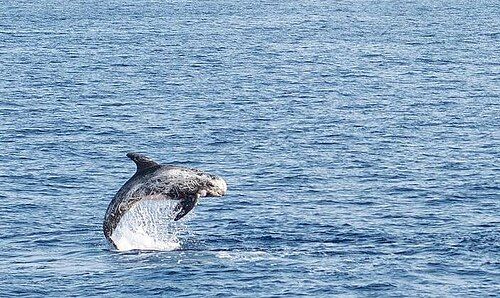

A blunt-headed dolphin covered in white scars from squid and other Risso's.
Fun factIts scars build up over its life until older adults look almost white.
- Waters
- Worldwide, Northeast US
- Depth zone
- Open-ocean surface waters
- Diet
- Squid
- Size
- Up to 4 m
Classification
Chordata › Mammalia › Artiodactyla › Delphinidae
- Kingdom Animalia animals
- Many-celled organisms that eat other living things for energy (heterotrophs)
- Cells have no cell walls
- Most can move at some stage of life
- Clade Bilateria bilateral animals
- Body has a left and right side that mirror each other (bilateral symmetry)
- Head end with concentrated nerves; three tissue layers
- Includes about 99% of all living animal species
- Clade Deuterostomia deuterostomes
- In the embryo, the first opening becomes the anus and the mouth forms second
- Includes echinoderms and chordates
- Phylum Chordata chordates
- At some stage of life: a stiffening rod along the back (notochord)
- A hollow nerve cord along the back (dorsal)
- Slits in the throat (pharyngeal slits) and a tail past the anus
- Subphylum Vertebrata vertebrates
- A skull (cranium) protecting a brain
- Backbone or similar support around the nerve cord
- Includes fishes, amphibians, reptiles, birds, and mammals
- Infraphylum Gnathostomata jawed vertebrates
- Jawed vertebrates: jaws formed from gill arches
- Paired fins or limbs
- Includes all fishes except hagfish and lampreys, plus all tetrapods
- Superclass Osteichthyes bony vertebrates
- Bony vertebrates: skeleton made largely of bone
- Most have a lung or swim bladder
- Includes ray-finned and lobe-finned fishes and all tetrapods
- Clade Sarcopterygii lobe-finned vertebrates
- Lobe-finned: fleshy fins with bones like those of limbs
- Includes coelacanths, lungfishes, and all tetrapods
- Clade Tetrapoda four-limbed vertebrates
- Four limbs with fingers and toes (or descended from animals that had them)
- Breathe air with lungs
- Class Mammalia mammals
- Mammals: hair at some stage of life
- Females nurse their young with milk (mammary glands)
- Three small bones in the middle ear
- Superorder Laurasiatheria whales, carnivorans & kin
- Large group of placental mammals including whales, carnivores, bats, and hoofed animals
- Order Artiodactyla even-toed hoofed mammals (whales included)
- Even-toed hoofed mammals (cows, deer, hippos) and their relatives the whales
- Whales evolved from land ancestors close to hippos
- Infraorder Cetacea whales, dolphins & porpoises
- Whales, dolphins, and porpoises: fully aquatic, with flippers and a horizontal tail fluke
- Breathe through a blowhole on top of the head
- Thick blubber instead of fur
- Parvorder Odontoceti toothed whales
- Toothed whales: teeth instead of baleen
- One blowhole
- Find prey by echolocation using a fatty 'melon' in the forehead
- Family Delphinidae oceanic dolphins
- Oceanic dolphins: most have a beak and a curved dorsal fin
- Includes orcas and pilot whales
- Genus Grampus
- Species in the same genus are very close relatives and often look alike.
- Species Grampus griseus Risso's dolphin
Closest relatives in the guide
- Atlantic spotted dolphin Stenella frontalis same family
- Atlantic white-sided dolphin Lagenorhynchus acutus same family
- Common bottlenose dolphin Tursiops truncatus same family
- Common dolphin Delphinus delphis same family
- Long-finned pilot whale Globicephala melas same family
- Orca Orcinus orca same family
- Spinner dolphin Stenella longirostris same family
- Beluga whale Delphinapterus leucas same order