Chordata · chordates
Alewife
Alosa pseudoharengus
Clupeidae · herrings, shads & sardinesIUCN: Least Concern
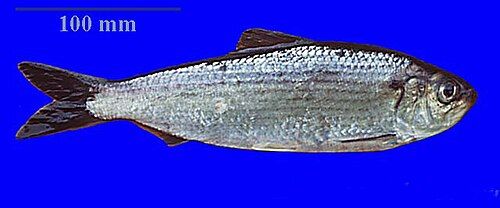

A river herring that runs up New England streams each spring.
Fun factMany towns run volunteer fish counts during the spring alewife run.
- Waters
- Northeast US, Northwest Atlantic
- Depth zone
- Coastal shallows & estuaries
- Diet
- Plankton
- Size
- Up to 38 cm
Classification
Chordata › Actinopterygii › Clupeiformes › Clupeidae
- Kingdom Animalia animals
- Many-celled organisms that eat other living things for energy (heterotrophs)
- Cells have no cell walls
- Most can move at some stage of life
- Clade Bilateria bilateral animals
- Body has a left and right side that mirror each other (bilateral symmetry)
- Head end with concentrated nerves; three tissue layers
- Includes about 99% of all living animal species
- Clade Deuterostomia deuterostomes
- In the embryo, the first opening becomes the anus and the mouth forms second
- Includes echinoderms and chordates
- Phylum Chordata chordates
- At some stage of life: a stiffening rod along the back (notochord)
- A hollow nerve cord along the back (dorsal)
- Slits in the throat (pharyngeal slits) and a tail past the anus
- Subphylum Vertebrata vertebrates
- A skull (cranium) protecting a brain
- Backbone or similar support around the nerve cord
- Includes fishes, amphibians, reptiles, birds, and mammals
- Infraphylum Gnathostomata jawed vertebrates
- Jawed vertebrates: jaws formed from gill arches
- Paired fins or limbs
- Includes all fishes except hagfish and lampreys, plus all tetrapods
- Superclass Osteichthyes bony vertebrates
- Bony vertebrates: skeleton made largely of bone
- Most have a lung or swim bladder
- Includes ray-finned and lobe-finned fishes and all tetrapods
- Class Actinopterygii ray-finned fishes
- Ray-finned fishes: fins are webs of skin held up by thin bony rays
- Usually a gas-filled swim bladder for buoyancy
- About half of all vertebrate species
- Infraclass Teleostei teleost fishes
- Teleosts: symmetrical tail fin
- Jaws that can push forward to grab prey (protrusible)
- About 96% of all living fishes
- Cohort Otocephala herrings, catfishes & kin
- Share a link between the swim bladder and inner ear in many members
- Includes herrings, catfishes, and carps
- Order Clupeiformes herrings & anchovies
- Herrings and anchovies: silvery, schooling filter-feeders
- Single dorsal fin and no spines in the fins
- Family Clupeidae herrings, shads & sardines
- Herrings, shads, and sardines: sharp scales along the belly (scutes)
- Genus Alosa
- Species in the same genus are very close relatives and often look alike.
- Species Alosa pseudoharengus Alewife
Closest relatives in the guide
- American shad Alosa sapidissima same genus
- Blueback herring Alosa aestivalis same genus
- Atlantic herring Clupea harengus same family
- Atlantic menhaden Brevoortia tyrannus same family
- European pilchard Sardina pilchardus same family
- Bay anchovy Anchoa mitchilli same order
- Northern anchovy Engraulis mordax same order
- Acadian redfish Sebastes fasciatus same class