Chordata · chordates
Blueback herring
Alosa aestivalis
Clupeidae · herrings, shads & sardinesIUCN: Vulnerable
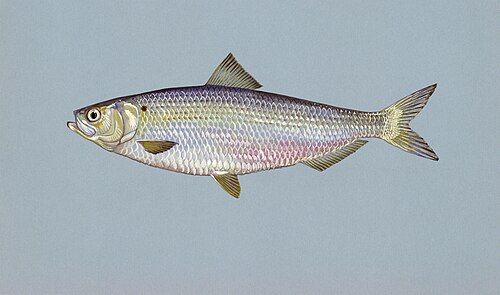

A river herring that spawns in faster, warmer water than its close cousin the alewife.
Fun factIt and the alewife are managed together as 'river herring,' and many states have closed their harvest.
- Waters
- Northeast US, Northwest Atlantic
- Depth zone
- Coastal shallows & estuaries, Open-ocean surface waters
- Diet
- Plankton
- Size
- Up to 40 cm
Classification
Chordata › Actinopterygii › Clupeiformes › Clupeidae
- Kingdom Animalia animals
- Many-celled organisms that eat other living things for energy (heterotrophs)
- Cells have no cell walls
- Most can move at some stage of life
- Clade Bilateria bilateral animals
- Body has a left and right side that mirror each other (bilateral symmetry)
- Head end with concentrated nerves; three tissue layers
- Includes about 99% of all living animal species
- Clade Deuterostomia deuterostomes
- In the embryo, the first opening becomes the anus and the mouth forms second
- Includes echinoderms and chordates
- Phylum Chordata chordates
- At some stage of life: a stiffening rod along the back (notochord)
- A hollow nerve cord along the back (dorsal)
- Slits in the throat (pharyngeal slits) and a tail past the anus
- Subphylum Vertebrata vertebrates
- A skull (cranium) protecting a brain
- Backbone or similar support around the nerve cord
- Includes fishes, amphibians, reptiles, birds, and mammals
- Infraphylum Gnathostomata jawed vertebrates
- Jawed vertebrates: jaws formed from gill arches
- Paired fins or limbs
- Includes all fishes except hagfish and lampreys, plus all tetrapods
- Superclass Osteichthyes bony vertebrates
- Bony vertebrates: skeleton made largely of bone
- Most have a lung or swim bladder
- Includes ray-finned and lobe-finned fishes and all tetrapods
- Class Actinopterygii ray-finned fishes
- Ray-finned fishes: fins are webs of skin held up by thin bony rays
- Usually a gas-filled swim bladder for buoyancy
- About half of all vertebrate species
- Infraclass Teleostei teleost fishes
- Teleosts: symmetrical tail fin
- Jaws that can push forward to grab prey (protrusible)
- About 96% of all living fishes
- Cohort Otocephala herrings, catfishes & kin
- Share a link between the swim bladder and inner ear in many members
- Includes herrings, catfishes, and carps
- Order Clupeiformes herrings & anchovies
- Herrings and anchovies: silvery, schooling filter-feeders
- Single dorsal fin and no spines in the fins
- Family Clupeidae herrings, shads & sardines
- Herrings, shads, and sardines: sharp scales along the belly (scutes)
- Genus Alosa
- Species in the same genus are very close relatives and often look alike.
- Species Alosa aestivalis Blueback herring
Closest relatives in the guide
- Alewife Alosa pseudoharengus same genus
- American shad Alosa sapidissima same genus
- Atlantic herring Clupea harengus same family
- Atlantic menhaden Brevoortia tyrannus same family
- European pilchard Sardina pilchardus same family
- Bay anchovy Anchoa mitchilli same order
- Northern anchovy Engraulis mordax same order
- Acadian redfish Sebastes fasciatus same class