Chordata · chordates
Atlantic sturgeon
Acipenser oxyrinchus
Acipenseridae · sturgeonsIUCN: Vulnerable
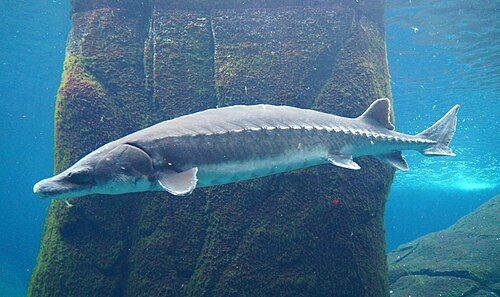

A bony-plated, ancient fish that returns from the ocean to spawn in the Hudson and Delaware rivers.
Fun factIts lineage goes back about 120 million years. Bony plates called scutes armor its body.
- Waters
- Northeast US, Northwest Atlantic
- Depth zone
- Coastal shallows & estuaries, Continental shelf
- Diet
- Worms, clams & crustaceans
- Size
- Up to 4.3 m
Classification
Chordata › Actinopterygii › Acipenseridae
- Kingdom Animalia animals
- Many-celled organisms that eat other living things for energy (heterotrophs)
- Cells have no cell walls
- Most can move at some stage of life
- Clade Bilateria bilateral animals
- Body has a left and right side that mirror each other (bilateral symmetry)
- Head end with concentrated nerves; three tissue layers
- Includes about 99% of all living animal species
- Clade Deuterostomia deuterostomes
- In the embryo, the first opening becomes the anus and the mouth forms second
- Includes echinoderms and chordates
- Phylum Chordata chordates
- At some stage of life: a stiffening rod along the back (notochord)
- A hollow nerve cord along the back (dorsal)
- Slits in the throat (pharyngeal slits) and a tail past the anus
- Subphylum Vertebrata vertebrates
- A skull (cranium) protecting a brain
- Backbone or similar support around the nerve cord
- Includes fishes, amphibians, reptiles, birds, and mammals
- Infraphylum Gnathostomata jawed vertebrates
- Jawed vertebrates: jaws formed from gill arches
- Paired fins or limbs
- Includes all fishes except hagfish and lampreys, plus all tetrapods
- Superclass Osteichthyes bony vertebrates
- Bony vertebrates: skeleton made largely of bone
- Most have a lung or swim bladder
- Includes ray-finned and lobe-finned fishes and all tetrapods
- Class Actinopterygii ray-finned fishes
- Ray-finned fishes: fins are webs of skin held up by thin bony rays
- Usually a gas-filled swim bladder for buoyancy
- About half of all vertebrate species
- Subclass Chondrostei sturgeons & paddlefishes
- Sturgeons and paddlefishes: mostly cartilage skeleton despite being bony fishes
- Shark-like tail with a longer upper lobe
- Family Acipenseridae sturgeons
- Sturgeons: rows of bony plates (scutes) along the body
- Barbels in front of a toothless, tube-like mouth
- Genus Acipenser
- Species in the same genus are very close relatives and often look alike.
- Species Acipenser oxyrinchus Atlantic sturgeon
Closest relatives in the guide
- Shortnose sturgeon Acipenser brevirostrum same genus
- Beluga sturgeon Huso huso same family
- Acadian redfish Sebastes fasciatus same class
- Alaska pollock Gadus chalcogrammus same class
- Albacore Thunnus alalunga same class
- Alewife Alosa pseudoharengus same class
- American conger Conger oceanicus same class
- American eel Anguilla rostrata same class