Cnidaria · cnidarians
Elkhorn coral
Acropora palmata
Acroporidae · staghorn & table coralsIUCN: Critically Endangered
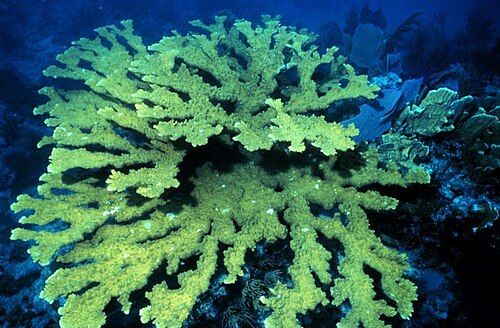

A Caribbean coral with flattened, antler-like branches that builds shallow reef crests.
Fun factIts reef crests break waves and help protect coastlines from storm surge.
- Waters
- Tropical Atlantic & Caribbean
- Depth zone
- Coral reefs
- Diet
- Plankton & symbiotic algae
- Size
- Colonies up to 4 m across
Classification
Cnidaria › Anthozoa › Scleractinia › Acroporidae
- Kingdom Animalia animals
- Many-celled organisms that eat other living things for energy (heterotrophs)
- Cells have no cell walls
- Most can move at some stage of life
- Phylum Cnidaria cnidarians
- Radially symmetric bodies with one opening that is both mouth and anus
- Stinging cells (cnidocytes) fire tiny harpoons (nematocysts)
- Two body forms: an attached polyp and a swimming bell (medusa)
- Class Anthozoa corals & anemones
- Live only as polyps; there is no swimming jellyfish stage
- Gut is divided by internal walls (mesenteries)
- Includes corals and sea anemones
- Subclass Hexacorallia stony corals & anemones
- Tentacles and internal walls come in multiples of six
- Includes stony corals and sea anemones
- Order Scleractinia stony corals
- Polyps build a hard limestone skeleton (calcium carbonate)
- Many reef species host algae (zooxanthellae) that feed them through photosynthesis
- Main builders of coral reefs
- Family Acroporidae staghorn & table corals
- Fast-growing branching, table, or plate-shaped corals
- Small polyps, with one larger polyp at each branch tip (axial corallite)
- Genus Acropora
- Species in the same genus are very close relatives and often look alike.
- Species Acropora palmata Elkhorn coral
Closest relatives in the guide
- Staghorn coral Acropora cervicornis same genus
- Grooved brain coral Diploria labyrinthiformis same order
- Northern star coral Astrangia poculata same order
- Common sea fan Gorgonia ventalina same class
- Frilled anemone Metridium senile same class
- Giant green anemone Anthopleura xanthogrammica same class
- Magnificent sea anemone Heteractis magnifica same class
- Northern red anemone Urticina felina same class