Cnidaria · cnidarians
Northern red anemone
Urticina felina
Actiniidae · common anemonesIUCN: Not evaluated
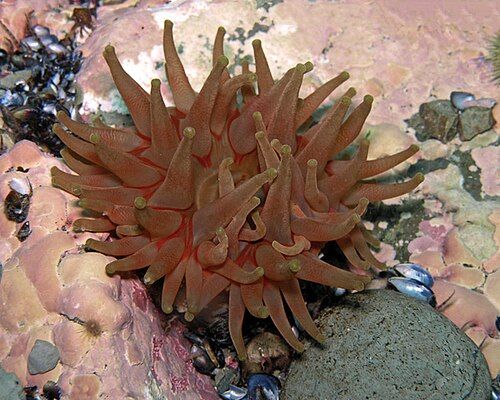

A thick red-and-green anemone of cold rocky shores.
Fun factIt sticks gravel and shell fragments to its column as camouflage.
- Waters
- Northeast US, Northwest Atlantic, Northeast Atlantic, Arctic Ocean
- Depth zone
- Intertidal shore, Coastal shallows & estuaries
- Diet
- Shrimp, crabs & small fish
- Size
- Up to 20 cm across
Classification
Cnidaria › Anthozoa › Actiniaria › Actiniidae
- Kingdom Animalia animals
- Many-celled organisms that eat other living things for energy (heterotrophs)
- Cells have no cell walls
- Most can move at some stage of life
- Phylum Cnidaria cnidarians
- Radially symmetric bodies with one opening that is both mouth and anus
- Stinging cells (cnidocytes) fire tiny harpoons (nematocysts)
- Two body forms: an attached polyp and a swimming bell (medusa)
- Class Anthozoa corals & anemones
- Live only as polyps; there is no swimming jellyfish stage
- Gut is divided by internal walls (mesenteries)
- Includes corals and sea anemones
- Subclass Hexacorallia stony corals & anemones
- Tentacles and internal walls come in multiples of six
- Includes stony corals and sea anemones
- Order Actiniaria sea anemones
- Sea anemones: single, soft-bodied polyps without a skeleton
- Grip surfaces with a muscular base (pedal disc) and can slowly move
- Catch prey with a ring of stinging tentacles around the mouth
- Family Actiniidae common anemones
- The largest anemone family, common on rocky shores
- Usually stout with short, thick tentacles
- Genus Urticina
- Species in the same genus are very close relatives and often look alike.
- Species Urticina felina Northern red anemone
Closest relatives in the guide
- Giant green anemone Anthopleura xanthogrammica same family
- Frilled anemone Metridium senile same order
- Magnificent sea anemone Heteractis magnifica same order
- Common sea fan Gorgonia ventalina same class
- Elkhorn coral Acropora palmata same class
- Grooved brain coral Diploria labyrinthiformis same class
- Northern star coral Astrangia poculata same class
- Staghorn coral Acropora cervicornis same class