Arthropoda · arthropods
Gooseneck barnacle
Pollicipes pollicipes
Pollicipedidae · goose barnaclesIUCN: Not evaluated
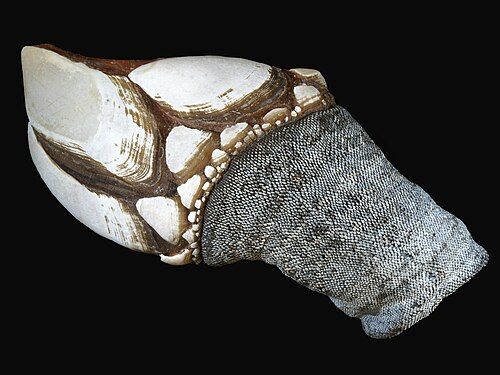

A stalked barnacle of wave-beaten rocks, prized as percebes in Spain.
Fun factHarvesters risk dangerous surf to collect it.
- Waters
- Northeast Atlantic
- Depth zone
- Intertidal shore
- Diet
- Plankton (filter feeder)
- Size
- Up to 10 cm
Classification
Arthropoda › Thecostraca › Pollicipedidae
- Kingdom Animalia animals
- Many-celled organisms that eat other living things for energy (heterotrophs)
- Cells have no cell walls
- Most can move at some stage of life
- Clade Bilateria bilateral animals
- Body has a left and right side that mirror each other (bilateral symmetry)
- Head end with concentrated nerves; three tissue layers
- Includes about 99% of all living animal species
- Clade Protostomia protostomes
- In the embryo, the first opening usually becomes the mouth
- Main nerve cord runs along the belly (ventral)
- Includes mollusks, worms, and arthropods
- Clade Ecdysozoa molting animals
- Grow by shedding their outer layer (molting, ecdysis)
- No cilia used for movement
- Includes arthropods and nematode worms
- Phylum Arthropoda arthropods
- Hard outer skeleton made of chitin (exoskeleton)
- Jointed legs and a segmented body
- The largest animal phylum by species count
- Subphylum Crustacea crustaceans
- Two pairs of antennae
- Branched (biramous) legs in many species
- Most breathe with gills
- Class Thecostraca barnacles
- Barnacles: adults cement themselves head-down to a surface
- Kick food into the mouth with feathery legs (cirri)
- Family Pollicipedidae goose barnacles
- Goose barnacles on a fleshy stalk (peduncle)
- Genus Pollicipes
- Species in the same genus are very close relatives and often look alike.
- Species Pollicipes pollicipes Gooseneck barnacle
Closest relatives in the guide
- Northern rock barnacle Semibalanus balanoides same class