Cnidaria · cnidarians
Lion's mane jellyfish
Cyanea capillata
Cyaneidae · lion's mane jelliesIUCN: Not evaluated
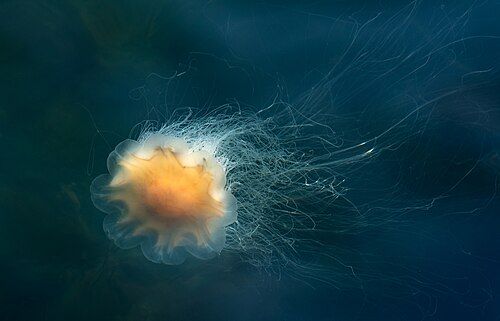

The largest known jellyfish, with masses of trailing tentacles.
Fun factOne that washed up in Massachusetts in 1865 had tentacles about 36 m long, longer than a blue whale.
- Waters
- Northeast US, Northwest Atlantic, Northeast Atlantic, Arctic Ocean, North Pacific
- Depth zone
- Coastal shallows & estuaries, Continental shelf, Open-ocean surface waters
- Diet
- Zooplankton, fish & other jellies
- Size
- Bell up to 2 m; tentacles over 30 m
Classification
Cnidaria › Scyphozoa › Semaeostomeae › Cyaneidae
- Kingdom Animalia animals
- Many-celled organisms that eat other living things for energy (heterotrophs)
- Cells have no cell walls
- Most can move at some stage of life
- Phylum Cnidaria cnidarians
- Radially symmetric bodies with one opening that is both mouth and anus
- Stinging cells (cnidocytes) fire tiny harpoons (nematocysts)
- Two body forms: an attached polyp and a swimming bell (medusa)
- Class Scyphozoa true jellyfish
- True jellyfish: the swimming bell (medusa) is the main life stage
- Small polyps bud off baby jellies by splitting in stacks (strobilation)
- Bell edge has sense organs (rhopalia) in notches
- Order Semaeostomeae flag-mouth jellyfish
- Jellies with four long, frilly oral arms hanging from the mouth
- Tentacles hang from the edge of the bell
- Family Cyaneidae lion's mane jellies
- Lion's mane jellies with dense clusters of long tentacles under the bell
- Bell can reach more than 2 m across
- Genus Cyanea
- Species in the same genus are very close relatives and often look alike.
- Species Cyanea capillata Lion's mane jellyfish
Closest relatives in the guide
- Atlantic sea nettle Chrysaora chesapeakei same order
- Mauve stinger Pelagia noctiluca same order
- Moon jelly Aurelia aurita same order
- Upside-down jellyfish Cassiopea xamachana same class