Cnidaria · cnidarians
Upside-down jellyfish
Cassiopea xamachana
Cassiopeidae · upside-down jelliesIUCN: Not evaluated
.jpg)
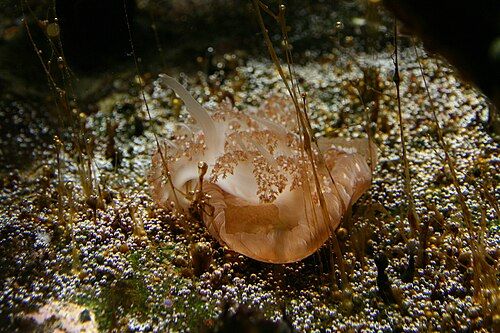
A jelly that lies bell-down in shallow lagoons and mangroves with its tentacles facing the sun.
Fun factIt releases stinging mucus 'grenades' into the water, so swimmers can be stung without touching it.
- Waters
- Tropical Atlantic & Caribbean
- Depth zone
- Coastal shallows & estuaries
- Diet
- Symbiotic algae & plankton
- Size
- Bell up to 25 cm
Classification
Cnidaria › Scyphozoa › Rhizostomeae › Cassiopeidae
- Kingdom Animalia animals
- Many-celled organisms that eat other living things for energy (heterotrophs)
- Cells have no cell walls
- Most can move at some stage of life
- Phylum Cnidaria cnidarians
- Radially symmetric bodies with one opening that is both mouth and anus
- Stinging cells (cnidocytes) fire tiny harpoons (nematocysts)
- Two body forms: an attached polyp and a swimming bell (medusa)
- Class Scyphozoa true jellyfish
- True jellyfish: the swimming bell (medusa) is the main life stage
- Small polyps bud off baby jellies by splitting in stacks (strobilation)
- Bell edge has sense organs (rhopalia) in notches
- Order Rhizostomeae root-mouth jellyfish
- No tentacles on the bell edge
- Instead of one mouth, oral arms have many tiny mouth openings
- Includes the edible jellyfish of Asia
- Family Cassiopeidae upside-down jellies
- Upside-down jellies that rest bell-down on the seafloor
- Host algae in their arms and face them toward the sun
- Genus Cassiopea
- Species in the same genus are very close relatives and often look alike.
- Species Cassiopea xamachana Upside-down jellyfish
Closest relatives in the guide
- Atlantic sea nettle Chrysaora chesapeakei same class
- Lion's mane jellyfish Cyanea capillata same class
- Mauve stinger Pelagia noctiluca same class
- Moon jelly Aurelia aurita same class