Mollusca · mollusks
Red abalone
Haliotis rufescens
Haliotidae · abalonesIUCN: Critically Endangered
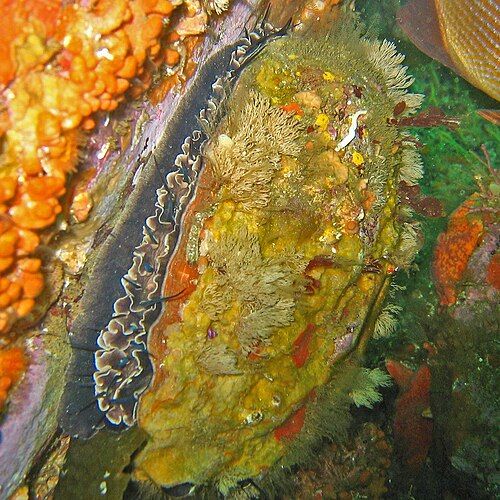

The world's largest abalone, living in California kelp forests.
Fun factCalifornia's red abalone recreational fishery has been closed since 2018.
- Waters
- Eastern Pacific
- Depth zone
- Coastal shallows & estuaries
- Diet
- Kelp & algae
- Size
- Shell up to 30 cm
Classification
Mollusca › Gastropoda › Haliotidae
- Kingdom Animalia animals
- Many-celled organisms that eat other living things for energy (heterotrophs)
- Cells have no cell walls
- Most can move at some stage of life
- Clade Bilateria bilateral animals
- Body has a left and right side that mirror each other (bilateral symmetry)
- Head end with concentrated nerves; three tissue layers
- Includes about 99% of all living animal species
- Clade Protostomia protostomes
- In the embryo, the first opening usually becomes the mouth
- Main nerve cord runs along the belly (ventral)
- Includes mollusks, worms, and arthropods
- Clade Spiralia mollusks, worms & kin
- Embryos usually divide in a spiral pattern (spiral cleavage)
- Many have a swimming larva with a band of cilia (trochophore)
- Includes mollusks and segmented worms
- Phylum Mollusca mollusks
- Soft body with a muscular foot and a fold of tissue (mantle) that makes the shell
- Most have a rasping, tongue-like ribbon of teeth (radula)
- Includes snails, clams, octopuses, and chitons
- Class Gastropoda snails & slugs
- Snails and slugs, most with a single, often coiled shell
- Body twists 180 degrees during development (torsion)
- Crawl on a broad muscular foot
- Subclass Vetigastropoda abalones & top snails
- Snails with slits or holes in the shell for exhaled water
- Includes abalones, limpets, and top snails
- Family Haliotidae abalones
- Abalones: flat, ear-shaped shells lined with mother-of-pearl
- A row of holes along the shell edge for breathing
- Genus Haliotis
- Species in the same genus are very close relatives and often look alike.
- Species Haliotis rufescens Red abalone
Closest relatives in the guide
- Atlantic oyster drill Urosalpinx cinerea same class
- Atlantic slipper snail Crepidula fornicata same class
- Blue dragon Glaucus atlanticus same class
- California sea hare Aplysia californica same class
- Channeled whelk Busycotypus canaliculatus same class
- Common periwinkle Littorina littorea same class
- Geography cone Conus geographus same class
- Knobbed whelk Busycon carica same class