Chordata · chordates
Thorny skate
Amblyraja radiata
Rajidae · hardnose skatesIUCN: Vulnerable
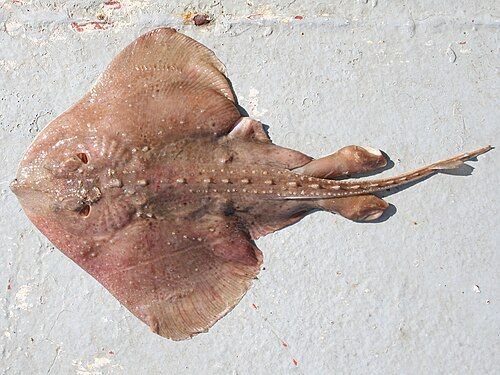

A cold-water skate of the Northwest Atlantic shelf, studded with thorny bucklers.
Fun factIts Gulf of Maine stock fell so low that keeping thorny skates has been banned in US waters since 2003.
- Waters
- Northeast US, Northwest Atlantic, Northeast Atlantic, Arctic Ocean
- Depth zone
- Continental shelf, Deep sea & continental slope
- Diet
- Crabs, shrimp, worms & fish
- Size
- Up to 1.1 m
Classification
Chordata › Chondrichthyes › Rajiformes › Rajidae
- Kingdom Animalia animals
- Many-celled organisms that eat other living things for energy (heterotrophs)
- Cells have no cell walls
- Most can move at some stage of life
- Clade Bilateria bilateral animals
- Body has a left and right side that mirror each other (bilateral symmetry)
- Head end with concentrated nerves; three tissue layers
- Includes about 99% of all living animal species
- Clade Deuterostomia deuterostomes
- In the embryo, the first opening becomes the anus and the mouth forms second
- Includes echinoderms and chordates
- Phylum Chordata chordates
- At some stage of life: a stiffening rod along the back (notochord)
- A hollow nerve cord along the back (dorsal)
- Slits in the throat (pharyngeal slits) and a tail past the anus
- Subphylum Vertebrata vertebrates
- A skull (cranium) protecting a brain
- Backbone or similar support around the nerve cord
- Includes fishes, amphibians, reptiles, birds, and mammals
- Infraphylum Gnathostomata jawed vertebrates
- Jawed vertebrates: jaws formed from gill arches
- Paired fins or limbs
- Includes all fishes except hagfish and lampreys, plus all tetrapods
- Class Chondrichthyes cartilaginous fishes
- Skeleton made of cartilage, not bone
- Skin covered in tooth-like scales (denticles)
- Teeth constantly replaced; males have claspers for mating
- Subclass Elasmobranchii sharks & rays
- Sharks and rays: five to seven separate gill slits on each side
- Many rows of replaceable teeth
- Superorder Batoidea rays & skates
- Rays and skates: flattened bodies with gill slits underneath
- Pectoral fins joined to the head
- Many have crushing, pavement-like teeth
- Order Rajiformes skates
- Skates: lay leathery egg cases ('mermaid's purses')
- Many have rows of thorny bumps along the back and tail
- Family Rajidae hardnose skates
- Hardnose skates with a stiff snout
- Genus Amblyraja
- Species in the same genus are very close relatives and often look alike.
- Species Amblyraja radiata Thorny skate
Closest relatives in the guide
- Barndoor skate Dipturus laevis same family
- Clearnose skate Rostroraja eglanteria same family
- Little skate Leucoraja erinacea same family
- Winter skate Leucoraja ocellata same family
- Atlantic angel shark Squatina dumeril same class
- Atlantic sharpnose shark Rhizoprionodon terraenovae same class
- Atlantic torpedo Tetronarce nobiliana same class
- Basking shark Cetorhinus maximus same class