Chordata · chordates
Diamondback terrapin
Malaclemys terrapin
Emydidae · pond turtles & terrapinsIUCN: Vulnerable
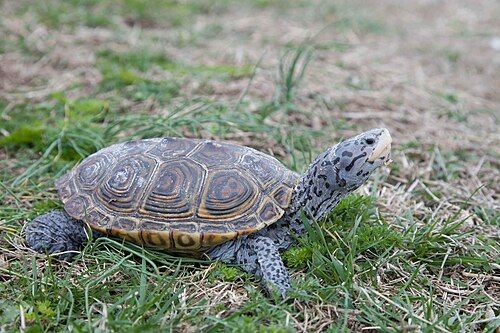

The only US turtle that lives in brackish salt marshes.
Fun factIt was nearly wiped out in the early 1900s as a gourmet soup ingredient.
- Waters
- Northeast US, Northwest Atlantic
- Depth zone
- Coastal shallows & estuaries, Intertidal shore
- Diet
- Snails, crabs & clams
- Size
- Shell up to 23 cm
Classification
Chordata › Reptilia › Testudines › Emydidae
- Kingdom Animalia animals
- Many-celled organisms that eat other living things for energy (heterotrophs)
- Cells have no cell walls
- Most can move at some stage of life
- Clade Bilateria bilateral animals
- Body has a left and right side that mirror each other (bilateral symmetry)
- Head end with concentrated nerves; three tissue layers
- Includes about 99% of all living animal species
- Clade Deuterostomia deuterostomes
- In the embryo, the first opening becomes the anus and the mouth forms second
- Includes echinoderms and chordates
- Phylum Chordata chordates
- At some stage of life: a stiffening rod along the back (notochord)
- A hollow nerve cord along the back (dorsal)
- Slits in the throat (pharyngeal slits) and a tail past the anus
- Subphylum Vertebrata vertebrates
- A skull (cranium) protecting a brain
- Backbone or similar support around the nerve cord
- Includes fishes, amphibians, reptiles, birds, and mammals
- Infraphylum Gnathostomata jawed vertebrates
- Jawed vertebrates: jaws formed from gill arches
- Paired fins or limbs
- Includes all fishes except hagfish and lampreys, plus all tetrapods
- Superclass Osteichthyes bony vertebrates
- Bony vertebrates: skeleton made largely of bone
- Most have a lung or swim bladder
- Includes ray-finned and lobe-finned fishes and all tetrapods
- Clade Sarcopterygii lobe-finned vertebrates
- Lobe-finned: fleshy fins with bones like those of limbs
- Includes coelacanths, lungfishes, and all tetrapods
- Clade Tetrapoda four-limbed vertebrates
- Four limbs with fingers and toes (or descended from animals that had them)
- Breathe air with lungs
- Class Reptilia reptiles (birds included)
- Scaly skin made of keratin
- Lay shelled eggs on land or carry eggs inside the body (amniotic egg)
- In modern classification this group includes birds
- Order Testudines turtles
- Turtles: body enclosed in a shell made of a top shield (carapace) and a bottom shield (plastron)
- Toothless beak
- Family Emydidae pond turtles & terrapins
- Pond turtles and terrapins with hard shells and webbed feet
- Diamondback terrapins are the only US turtles of brackish marshes
- Genus Malaclemys
- Species in the same genus are very close relatives and often look alike.
- Species Malaclemys terrapin Diamondback terrapin
Closest relatives in the guide
- Green sea turtle Chelonia mydas same order
- Hawksbill sea turtle Eretmochelys imbricata same order
- Kemp's ridley sea turtle Lepidochelys kempii same order
- Leatherback sea turtle Dermochelys coriacea same order
- Loggerhead sea turtle Caretta caretta same order
- African penguin Spheniscus demersus same class
- Arctic tern Sterna paradisaea same class
- Atlantic puffin Fratercula arctica same class