Chordata · chordates
Kemp's ridley sea turtle
Lepidochelys kempii
Cheloniidae · hard-shelled sea turtlesIUCN: Critically Endangered
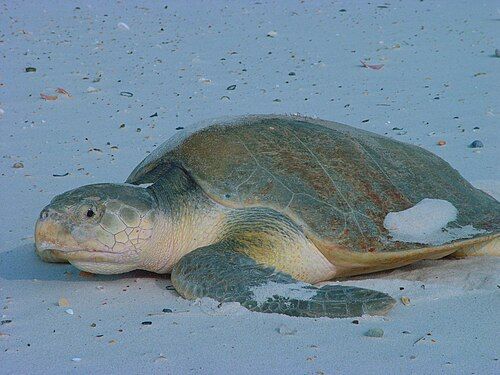

The smallest sea turtle and one of the most endangered. Juveniles forage in Long Island Sound and Cape Cod Bay.
Fun factFemales nest by the thousands in synchronized daytime arrivals called 'arribadas.'
- Waters
- Northeast US, Northwest Atlantic, Tropical Atlantic & Caribbean
- Depth zone
- Coastal shallows & estuaries
- Diet
- Crabs
- Size
- Up to 75 cm
Classification
Chordata › Reptilia › Testudines › Cheloniidae
- Kingdom Animalia animals
- Many-celled organisms that eat other living things for energy (heterotrophs)
- Cells have no cell walls
- Most can move at some stage of life
- Clade Bilateria bilateral animals
- Body has a left and right side that mirror each other (bilateral symmetry)
- Head end with concentrated nerves; three tissue layers
- Includes about 99% of all living animal species
- Clade Deuterostomia deuterostomes
- In the embryo, the first opening becomes the anus and the mouth forms second
- Includes echinoderms and chordates
- Phylum Chordata chordates
- At some stage of life: a stiffening rod along the back (notochord)
- A hollow nerve cord along the back (dorsal)
- Slits in the throat (pharyngeal slits) and a tail past the anus
- Subphylum Vertebrata vertebrates
- A skull (cranium) protecting a brain
- Backbone or similar support around the nerve cord
- Includes fishes, amphibians, reptiles, birds, and mammals
- Infraphylum Gnathostomata jawed vertebrates
- Jawed vertebrates: jaws formed from gill arches
- Paired fins or limbs
- Includes all fishes except hagfish and lampreys, plus all tetrapods
- Superclass Osteichthyes bony vertebrates
- Bony vertebrates: skeleton made largely of bone
- Most have a lung or swim bladder
- Includes ray-finned and lobe-finned fishes and all tetrapods
- Clade Sarcopterygii lobe-finned vertebrates
- Lobe-finned: fleshy fins with bones like those of limbs
- Includes coelacanths, lungfishes, and all tetrapods
- Clade Tetrapoda four-limbed vertebrates
- Four limbs with fingers and toes (or descended from animals that had them)
- Breathe air with lungs
- Class Reptilia reptiles (birds included)
- Scaly skin made of keratin
- Lay shelled eggs on land or carry eggs inside the body (amniotic egg)
- In modern classification this group includes birds
- Order Testudines turtles
- Turtles: body enclosed in a shell made of a top shield (carapace) and a bottom shield (plastron)
- Toothless beak
- Family Cheloniidae hard-shelled sea turtles
- Hard-shelled sea turtles: limbs shaped into flippers
- Can't pull their head into the shell
- Genus Lepidochelys
- Species in the same genus are very close relatives and often look alike.
- Species Lepidochelys kempii Kemp's ridley sea turtle
Closest relatives in the guide
- Green sea turtle Chelonia mydas same family
- Hawksbill sea turtle Eretmochelys imbricata same family
- Loggerhead sea turtle Caretta caretta same family
- Diamondback terrapin Malaclemys terrapin same order
- Leatherback sea turtle Dermochelys coriacea same order
- African penguin Spheniscus demersus same class
- Arctic tern Sterna paradisaea same class
- Atlantic puffin Fratercula arctica same class